Feature
Targeting more accurate methane emissions measurements in oil and gas
The energy sector has been found to hold 72% of methane mitigation potential, meaning emissions measurements have never been so important. Heidi Vella finds out about the latest, and largest, detection campaign in the North Sea.
Powered by

Main video supplied by Ashley Cooper/Corbis Video via Getty Images
Amid high tensions and political wrangling at COP30 this November, it wasn’t just CO₂ emission reductions that dominated the agenda but another potent pollutant: methane.
At a dedicated methane summit, a set of “landmark initiatives”’ were agreed upon to support global action on methane and other non-CO₂ greenhouse gases. Specifically, the initiative developed a plan to mobilise $150m as an “action accelerator” to support methane reductions. Following the talks, the UK released a statement on reducing methane emissions in the oil and gas sector specifically, outlining six actions, which included measurement and verification. The initiative follows the Global Methane Pledge, made in 2021, and the Oil and Gas Decarbonisation Charter (OGDC), inked two years later.
A few weeks prior to COP30, a timely report by the German Aerospace Centre (DLR) noted that, in an airborne measurement campaign of methane emissions from West African offshore facilities, emissions from offshore oil and gas platforms off the Angolan coast were more than twice the values reported by operators.
The findings highlighted how important it is to move from “estimates to actual data,” said Anke Roiger, head of the Atmospheric Trace Species Department at the DLR Institute of Atmospheric Physics.
“Only with reliable measurements can we understand the true scale of emissions and make informed decisions to reduce them,” she said.
Industry leaders take aim at methane
Eliminating methane emissions is hailed as the fastest, most effective way to slow the pace of climate change, because the gas is around 83-times stronger over a 30-year period than CO₂, and is estimated to be responsible for around 30% of the rise in global temperatures since the Industrial Revolution.
The oil and gas industry is therefore under immense pressure to act, facing the glare of increasing scrutiny, not only at COP but also via initiatives such as MethaneSat, which uses satellites to measure global methane emissions from oil and gas facilities.
Methane emissions from oil and gas operations account for almost a third of the global total and are caused primarily by leaks and flaring. Preventative measures are well-known: plugging wells, repair campaigns, installing emissions control devices and replacing components. However, accurate leak detection is a stumbling block, particularly for offshore.
Hamed Moshrefi, director of international and offshore business development at Bridger Photonics (a leading Light Detection and Ranging company that has worked with Chevron and ExxonMobil detecting methane emissions, primarily onshore), explains: “Offshore environments introduce a very different set of measurement challenges compared to onshore operations. Platforms are densely built with multi-level structures, equipment is congested and there is limited deck space, all of which can obstruct traditional sensor lines of sight. In addition, strong and shifting winds over open water further complicate the ability to capture stable, repeatable measurements.”
Measurement technologies have typically not been well-adapted to these conditions, being either too large or too costly, meaning the industry has relied mostly on estimates or periodic manual surveys, which can miss short-lived but high-volume leaks. This, however, is changing, with technology companies collaborating to adapt their equipment for the offshore environment.
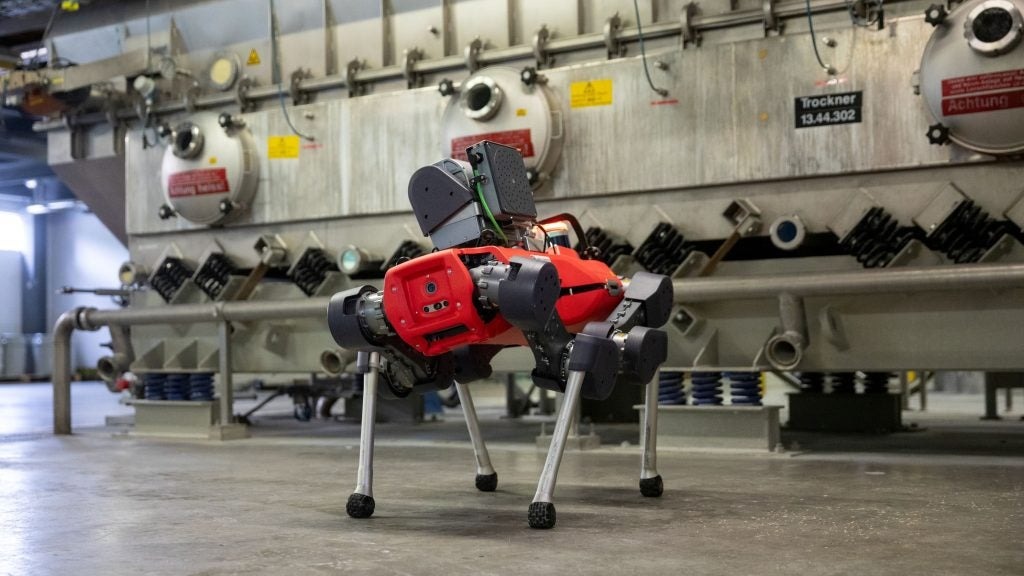
ANYmal can detect the presence of gas and potential leaks. Credit: ANYbotics
Roberta is engineered to be IP67-rated, making it waterproof, dust-proof and capable of operating in extreme industrial conditions including in snow, deserts and rainy environments. In the case of ex-certified ANYmal X, a temperature monitor ensures the maximum surface temperature does not pose an ignition risk, working along ex-certified components including batteries and fans.
The applications are plentiful. Roberta monitors CO₂ levels in the air and sends hazardous level alerts, but Assefi says “our robots can do so much more. ANYmals can perform regular autonomous inspection rounds and leverage the visual, thermal, acoustic and gas sensing capabilities. We can also conduct perimeter surveillance and do safety-critical monitoring; for example, during high pressure-pump tests.”
Brandtzæg calls Roberta’s deployment “a sign of early success”, noting that deployment represented a learning curve at Northern Lights. “The operators have started using it themselves and creating missions on their own, without the research and development team there,” he adds.
He acknowledges an odd hiccup: “There was one instance when it tripped and fell into a ditch; it had been cordoned off, but we hadn’t put it into the mission yet – this was good learning for us, the people on the ground and for ANYbotics, which has supported in the process of deploying in the real environment.”
Large-scale methane emissions measurement trial in the North Sea
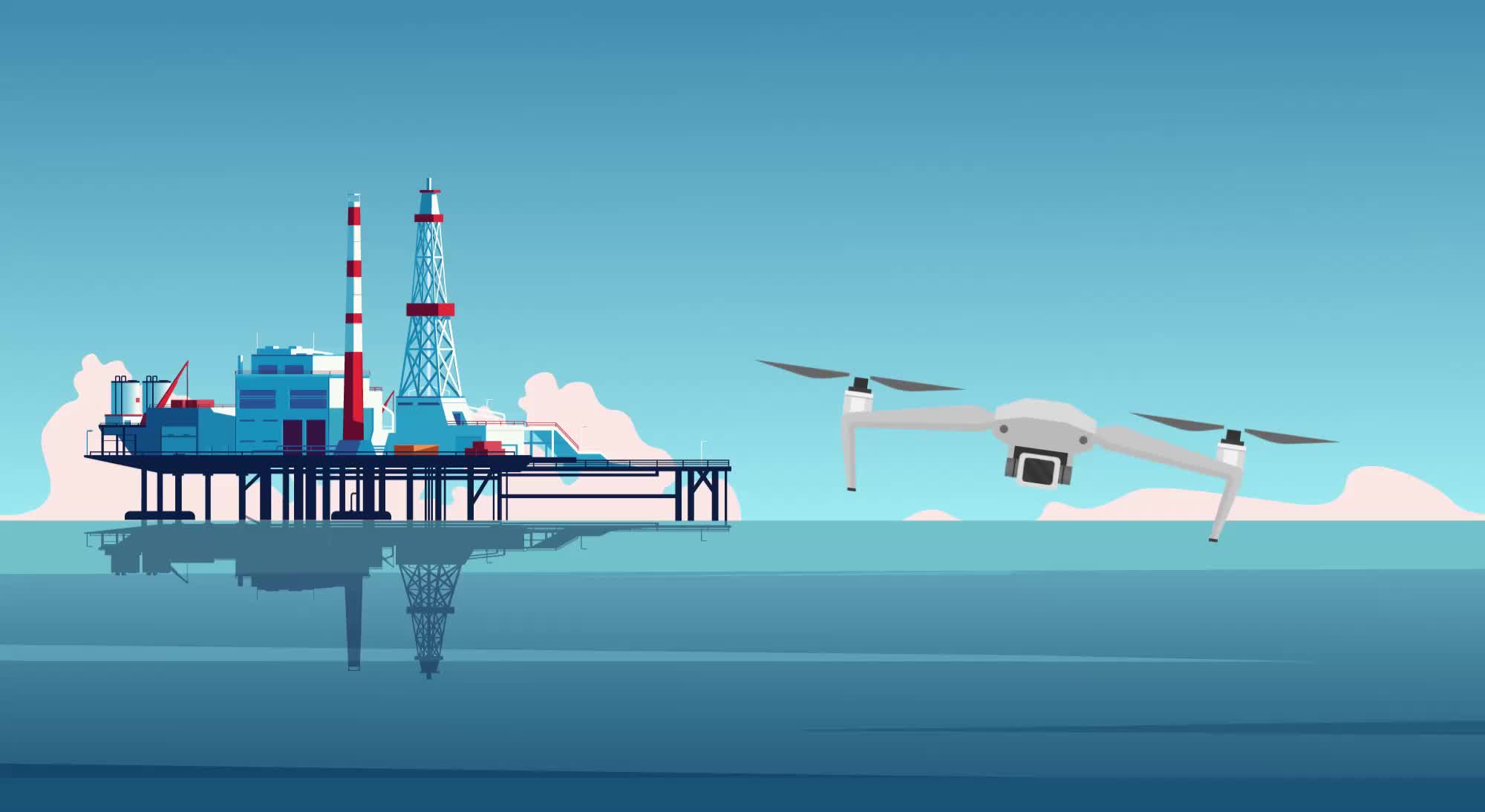
One of the most recent examples of this shift comes from drone inspection and data service companies Cyberhawk and Explicit which, in September, together completed one of the largest offshore campaigns, detecting and measuring emissions at 33 Equinor-operated offshore platforms in the harsh conditions of the Norwegian North Sea.
They used Cyberhawk-manned drones, equipped with Explicit’s methane-measurement and analytics technology, to conduct the multi-million-euro campaign, which ran for 353 days, covering an average of 6.3 assets per month and involving 701 flights.
Callum Kottis, senior vice-president at oil, gas and marine operations at Cyberhawk, tells Offshore Technology that the two companies worked collaboratively on mission planning, data-quality checks and adapting equipment for offshore conditions.
This integration was “essential”, he says, delivering reliable, repeatable measurements across a large fleet of platforms.
The data helped Equinor validate inventories and identify previously unknown methane sources. The campaign was part of the company’s aim to reduce the methane intensity of its oil and gas operations from the current 0.02% (around a tenth of the industry average) to near zero by 2030.
Kottis says that, during the North Sea campaign, challenges included turbine downwash (when a turbine’s exhaust gets pushed down towards the platform instead of safely dispersing upwards), varying wind conditions that influence plume dispersion and ensuring equipment was readily available across many assets.
“A major learning was the importance of consistent flight paths and repeatability to ensure high-quality, comparable data,” he explains.
He adds that one of the benefits of the Explicit methodology is that it can track wind variation with the same granularity as gas concentrations, which improves the measurement accuracy and the ability to track source origin.
The companies are now working to further improve weather resilience and source tracking, so they can eventually visualise emissions.
The future is autonomous
Costs for such campaigns can vary, depending on the days required in the field and the time needed for data analysis and reporting, as well as the technical requirements, says Kottis.
He explains that for a hypothetical offshore oil and gas platform, responsible methane emissions measurement would involve conducting a baseline full-platform measurement, at least annually. This would most likely use aircraft, satellites and drones, or comprehensive on-platform surveys, to establish a high-confidence emissions inventory.
In addition, routine monitoring and verification would occur quarterly or semi-annually, using a mix of drone surveys, scanning lasers and continuous area monitoring.
The UN Environment Programme notes that the costs involved should be considered negligible to the industry; all fossil fuel mitigation measures could be implemented for 2% of the sector’s 2023 income.
However, the industry can achieve greater savings by introducing more autonomy to the process. French oil and gas major TotalEnergies, which aims to reduce methane emissions by 80% by 2030 compared to 2020, has worked with the French National Centre for Scientific Research and the University of Reims Champagne-Ardenne to develop an Airborne Ultralight Spectrometer for Environmental Applications. The technology encompasses a drone-mounted ultralight CO₂ and methane sensor for hard-to-reach emission points and delivers high-precision readings.
To date, it has completed more than 1,200 flights in eight countries over 125 sites, according to a TotalEnergies spokesperson, and the company is offering it to other OGDC members for trials.
Its stated aim, however, is to make the technology completely autonomous. Research teams are looking to develop an unmanned drone navigation system that automatically streams data to servers and instantaneously processes and reports it. Automating the system will deliver immediate results to local operators at the facilities and increase the number of flights, the spokesperson says.
Kottis agrees automation is the way forward – something Cyberhawk is actively exploring – because autonomy could dramatically reduce costs and deliver near-real-time insights.
However, several challenges remain, such as regulatory restrictions on autonomous flights offshore, ensuring robust data quality, battery limitations and integrating autonomous units safely into busy platform airspace.
“The technology is progressing quickly, and many components already exist, but stitching them together into a truly autonomous, reliable system requires significant testing,” Kottis explains.
“However, when it comes to delivering near-real-time insights, the industry is getting close. Over the past 18 months I have seen reporting timelines shrink from months, to weeks, to as little as 24 hours.”
AI is entering the equation to further improve autonomous measurement technology. BP and Microsoft have collaborated on AI systems that process sensor data to identify methane emissions in near-real-time to improve operational efficiency. Accenture and Microsoft have also developed Avanade to track and measure methane emissions using AI and satellite imagery from natural gas assets such as pipelines.
Bridger has also adapted its technology for the offshore environment. Moshrefi says the company is also integrating AI and machine learning to accelerate processing and delivery of emissions data.
“These tools help automate repeatable steps in our analysis pipeline, improve classification accuracy and increase the speed and consistency of turning raw measurements into actionable insights,” he says. Both Moshrefi and Kottis are seeing an accelerated shift across the industry when it comes to monitoring and measuring methane emissions.
Indeed, according to Oil and Gas Climate Initiative data, member companies’ aggregate upstream operated methane intensity was 0.12% in 2024, down 62% compared to 2017, although its membership represents only 25% of global output. Most fossil fuel production takes place in countries that have not yet joined the Global Methane Pledge.
Overall, Kottis says he would like to see broader collaboration from the oil and gas industry, as well as earlier engagement and more willingness to trial new technologies offshore to meet the wider methane reduction ambitions.
“The momentum is building and continued industry participation will be key to driving improvement in emissions transparency,” he concludes.
Various nations have already thrown their hats in the ring. Last year, Italy’s space programme announced it will reopen its ocean launch pad off the coast of Kenya, while German start-up Offshore Spaceport Alliance has proposed an offshore space port in the North Sea.
Perhaps most famously, in 2021, Elon Musk’s SpaceX announced it had purchased two oil rigs in the Gulf of Mexico to be converted into rocket launch pads.
However, the company later sold the rigs, saying greater understanding and development of Starship was needed, although it said offshore launch pads remained a key sector for development.
While a real-world repurposing example is yet to be seen, interest in the sector is heating up. As satellite demand grows and companies pursue high cadence launch strategies, offshore platforms could evolve from being novel experiments to core infrastructure in the space economy.

With robots, there is efficiency, frequency, repeatability and precision.
Magnus Rørvik Brandtzæg

Dr. David W. Bates, Chief of General Internal Medicine at Brigham and Women’s Hospital
Caption. Credit:
Total annual production

Australia could be one of the main beneficiaries of this dramatic increase in demand, where private companies and local governments alike are eager to expand the country’s nascent rare earths production. In 2021, Australia produced the fourth-most rare earths in the world. It’s total annual production of 19,958 tonnes remains significantly less than the mammoth 152,407 tonnes produced by China, but a dramatic improvement over the 1,995 tonnes produced domestically in 2011.
The dominance of China in the rare earths space has also encouraged other countries, notably the US, to look further afield for rare earth deposits to diversify their supply of the increasingly vital minerals. With the US eager to ringfence rare earth production within its allies as part of the Inflation Reduction Act, including potentially allowing the Department of Defense to invest in Australian rare earths, there could be an unexpected windfall for Australian rare earths producers.
