Feature
As Europe turns away from Russian gas, the US is ready to cash in
Ed Pearcey finds out why Russia and its energy companies "can no longer be considered reliable energy trading partners by the EU".
Powered by


Main video supplied by pashapixel/Creatas Video+ / Getty Images Plus via Getty Images
The US has become a major supplier of liquified natural gas (LNG) to Europe, with imports doubling since 2021.
This shift has been driven by several push and pull factors, most notably the EU’s plan to phase out Russian gas by 2027 and secure alternative energy sources to satisfy its energy needs.
Add to this the US’ desire to develop a huge market for its abundant gas supplies – which can be easily transported globally using liquefaction and regasification techniques – and you have what appears to be a marriage made in heaven.
Just last week at the annual Gastech conference, US Secretary of the Interior Doug Burgum urged European decisionmakers and energy executives in the audience in this very direction: “Peace is achieved around the world by selling our energy to our friends and allies who don’t have to buy from our adversaries.”
US LNG growth and Europe’s gas needs
According to GlobalData, Offshore Technology Focus’s parent company, the US became the world’s largest exporter of LNG in the first half of 2022 (H1 2022), with the country’s exports increasing by 12% compared with H2 2021, achieving an average of 11.2 billion cubic feet per day (bcf/d).
In response to increasing uncertainty over the supply of gas from Russia, the US is exporting record amounts of LNG to Europe to assist EU allies in their attempts to fill gas storage facilities in time for next winter.
According to the US Energy Information Administration (EIA), 64% of the country’s LNG exports went to the EU and the UK during the first five months of 2022. In 2024, the US exported 11.9bcf/d of LNG, fully establishing itself as the world’s largest LNG exporter, adds the EIA.
GlobalData’s Strategic Intelligence: Top 20 Oil & Gas Themes 2025 report states that by 2023, the EU had reduced its LNG imports from Russia to 15% of its total imports – from 45% immediately prior to the start of the Russia-Ukraine conflict.
However, the EU “faces a dilemma: whether to proceed with planned investments in new LNG regasification terminals or to reallocate some of those funds toward renewable energy initiatives while potentially resuming trade with Russia”, according to GlobalData.
Russia aside, Europe’s overall need for more gas could also be driving US imports, with Europe requiring “more gas imports as [European] gas production steadily declines”, says the GlobalData report. North America could account for up to 62% of the capacity coming online by 2025, it adds, further strengthening its position as an LNG supplier to the global market.
Ravindra Puranik, oil and gas analyst at GlobalData, says Europe’s strategic shift away from Russian energy exports “has resulted in key changes to the global energy supplies [and] this is anticipated to benefit the US shale oil and gas drillers, as well as LNG producers who are positioned to reap from these evolving supply chain dynamics”.
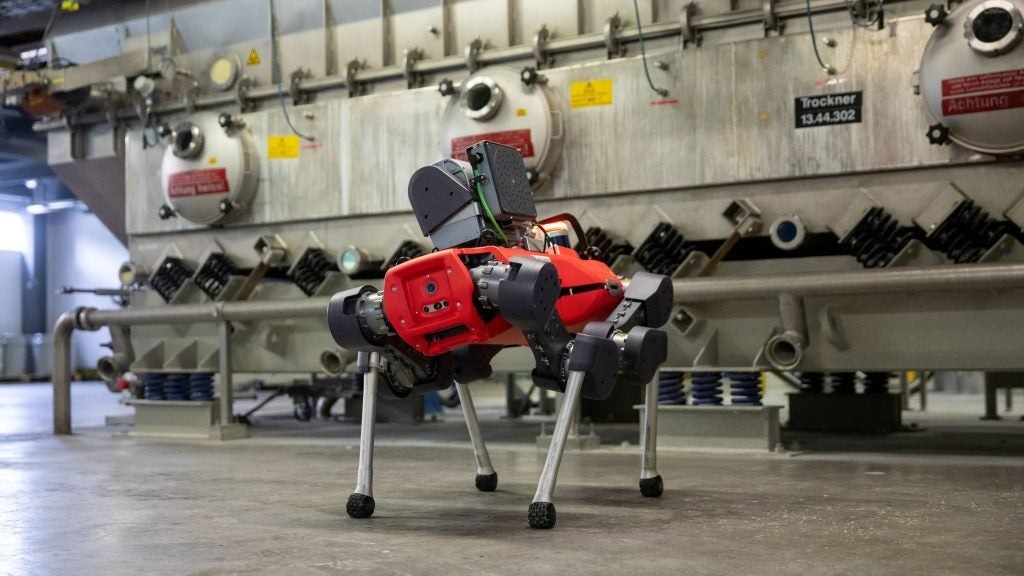
ANYmal can detect the presence of gas and potential leaks. Credit: ANYbotics
Roberta is engineered to be IP67-rated, making it waterproof, dust-proof and capable of operating in extreme industrial conditions including in snow, deserts and rainy environments. In the case of ex-certified ANYmal X, a temperature monitor ensures the maximum surface temperature does not pose an ignition risk, working along ex-certified components including batteries and fans.
The applications are plentiful. Roberta monitors CO₂ levels in the air and sends hazardous level alerts, but Assefi says “our robots can do so much more. ANYmals can perform regular autonomous inspection rounds and leverage the visual, thermal, acoustic and gas sensing capabilities. We can also conduct perimeter surveillance and do safety-critical monitoring; for example, during high pressure-pump tests.”
Brandtzæg calls Roberta’s deployment “a sign of early success”, noting that deployment represented a learning curve at Northern Lights. “The operators have started using it themselves and creating missions on their own, without the research and development team there,” he adds.
He acknowledges an odd hiccup: “There was one instance when it tripped and fell into a ditch; it had been cordoned off, but we hadn’t put it into the mission yet – this was good learning for us, the people on the ground and for ANYbotics, which has supported in the process of deploying in the real environment.”
EU’s position now clear
In June, the European Commission (EC) put forward a proposal to “gradually and effectively stop the import of Russian gas and oil into the EU by the end of 2027”.
“This will help the EU become more energy independent, improve the security of the energy supply, and boost the EU’s energy independence and competitiveness,” the official statement said.
This proposal follows the REPowerEU plan, the EU’s strategy to completely remove Russian oil, gas and nuclear energy imports from EU markets, which was introduced in 2022, followed by a road map this May. It includes steps for phasing out pipeline gas and LNG, as well as measures to facilitate the complete cessation of Russian oil imports by the end of 2027.
EU member countries will need to find alternative sources for up to 52 billion cubic metres of Russian natural gas supply within the next two years, with the package of measures including a ban on any new contracts with Russian companies.
The final proposal still needs to be ratified by the European Parliament before going into effect in 2026.
The need for energy security
Russian gas imports under new contracts will be prohibited as of 1 January 2026, while imports under existing short-term contracts will be stopped by 17 June 2026. Imports under long-term contracts will cease by the end of 2027.
The EC’s proposal adds that Russia “has repeatedly threatened the EU’s security of supply by unilaterally cutting gas flows to Europe, as happened in 2006, 2009 and 2014”, well before the invasion of Ukraine. The first two incidents were pricing disputes, while the last one was related to Russia’s annexation of Crimea.
The proposed regulation also makes it clear that the “Russian Federation and its energy companies can no longer be considered reliable energy trading partners by the EU”.
Russia’s impact goes far beyond energy security of supply, impacting the whole economy, adds the Commission, noting that “energy prices were the most important driver of inflation, which at its peak reached levels above 10% in 2022 across the EU”.
When asked why Europe is turning away from Russian gas, a representative of the EU Agency for the Cooperation of Energy Regulators (ACER), cites how the EU’s 2022 REPowerEU initiative “seeks to diversify Europe’s energy sources, boost renewable energy and improve energy efficiency”.
“The EU is diversifying its imports, and this diversification is supplier based, and the US is now the biggest supplier of LNG to Europe,” they add.
Mason Hamilton, chief economist at the American Petroleum Institute, confirms to Offshore Technology Focus that US natural gas exports to Europe “have gone up quite substantially over the past five years and collectively Europe is the top destination for our LNG exports, particularly Germany, which has turned away from Russian gas”.
Pricing and tariffs
The ACER representative adds that towards the end of winter 2024, European markets were “pricing at a distinctive premium to Asian spot LNG markets, and new gas liquification capacity starting to produce LNG in the US, saw EU LNG imports lifted to record highs”.
However, President Donald Trump’s threat to impose a 30% tariff on all imports from the EU is likely to produce reciprocal action, possibly impacting US LNG imports to the bloc, unless a carve out (or trade deal) can be found.
EC President Ursula von der Leyen indicated immediately after Trump’s election win in November 2024 that the EU may consider replacing Russian LNG imports with shipments from the US, which she said is “cheaper for us and brings down our energy prices”.
According to Anne-Sophie Corbeau, global research scholar at Columbia University’s Centre on Global Energy Policy, Trump “could potentially fulfil the role of ‘LNG Marketer in Chief’ to nudge EU companies to sign more US LNG contracts”.
“Higher EU imports of US LNG are likely to materialise in 2025 for two market-driven reasons, which have nothing to do with policies or politics,” adds Corbeau, in a blog from February 2025.
“US LNG exports are bound to increase, as two new liquefaction plants start in 2025, and the EU will need to import more LNG to compensate for the halt of the Russia-Ukraine gas transit deal on 1 January 2025, as well to refill EU storage facilities,” she concludes.
Meanwhile, Hamilton says that Europe is a wide-open market for LNG. US natural gas is increasingly going towards Europe as well as Asia and South America.
Equinor is enhancing the value of precision using AI and data analysis. Roberta, for instance, analyses videos using Equinor’s in-house algorithm to calculate the percentage of oil left in the glass of non-instrumented pumps and identify potential leaks. Similarly, it uses a computer vision algorithm to detect fence perimeter faults.
When it comes to adding value to Equinor’s operations, the future is in versatile and autonomous robotics. “Roberta at Northern Lights is a general-purpose inspection robot walking around and inspecting with a high level of autonomy, rather than carrying out one specific task, like our other remotely controlled robots,” says Brandtzæg.
“I see this as a potential development in the future: capabilities will be one dimension, and then autonomy will be the other.”

With robots, there is efficiency, frequency, repeatability and precision.
Magnus Rørvik Brandtzæg

Dr. David W. Bates, Chief of General Internal Medicine at Brigham and Women’s Hospital

Caption. Credit:
Total annual production

Australia could be one of the main beneficiaries of this dramatic increase in demand, where private companies and local governments alike are eager to expand the country’s nascent rare earths production. In 2021, Australia produced the fourth-most rare earths in the world. It’s total annual production of 19,958 tonnes remains significantly less than the mammoth 152,407 tonnes produced by China, but a dramatic improvement over the 1,995 tonnes produced domestically in 2011.
The dominance of China in the rare earths space has also encouraged other countries, notably the US, to look further afield for rare earth deposits to diversify their supply of the increasingly vital minerals. With the US eager to ringfence rare earth production within its allies as part of the Inflation Reduction Act, including potentially allowing the Department of Defense to invest in Australian rare earths, there could be an unexpected windfall for Australian rare earths producers.
